
Claude-by-Cheese
The State of the Paper
There is lots to say about how March came and went. Weather fluctuations that gave whiplash and clothing choice confusion. Days and nights of writing slowly and steadily. I did some heavy reconnaissance on what magazines I want to submit to. Ran through my piece, Their Forked and Destroying Tounges, to tweak and polish for submission. I am close to pulling the trigger on it and sending it out.
As far as this edition of the paper, we have a couple of interesting pieces for you. There is A Modern Tableau of Grief inspired from a recent walk I took with Greta. Then we have an excerpt from Ruth’s Great-Uncle’s academic journal, which Ruth has so graciously provided. This will be an ongoing series. As always we have Ruth’s book club, which leads us to the finale of the Red Devil Motel. I want to take the time to thank Nick for allowing his piece to be featured here. As always thank you for reading and supporting Philly’s #1 trash based paper.
-Niall
A Modern Tableau of Grief
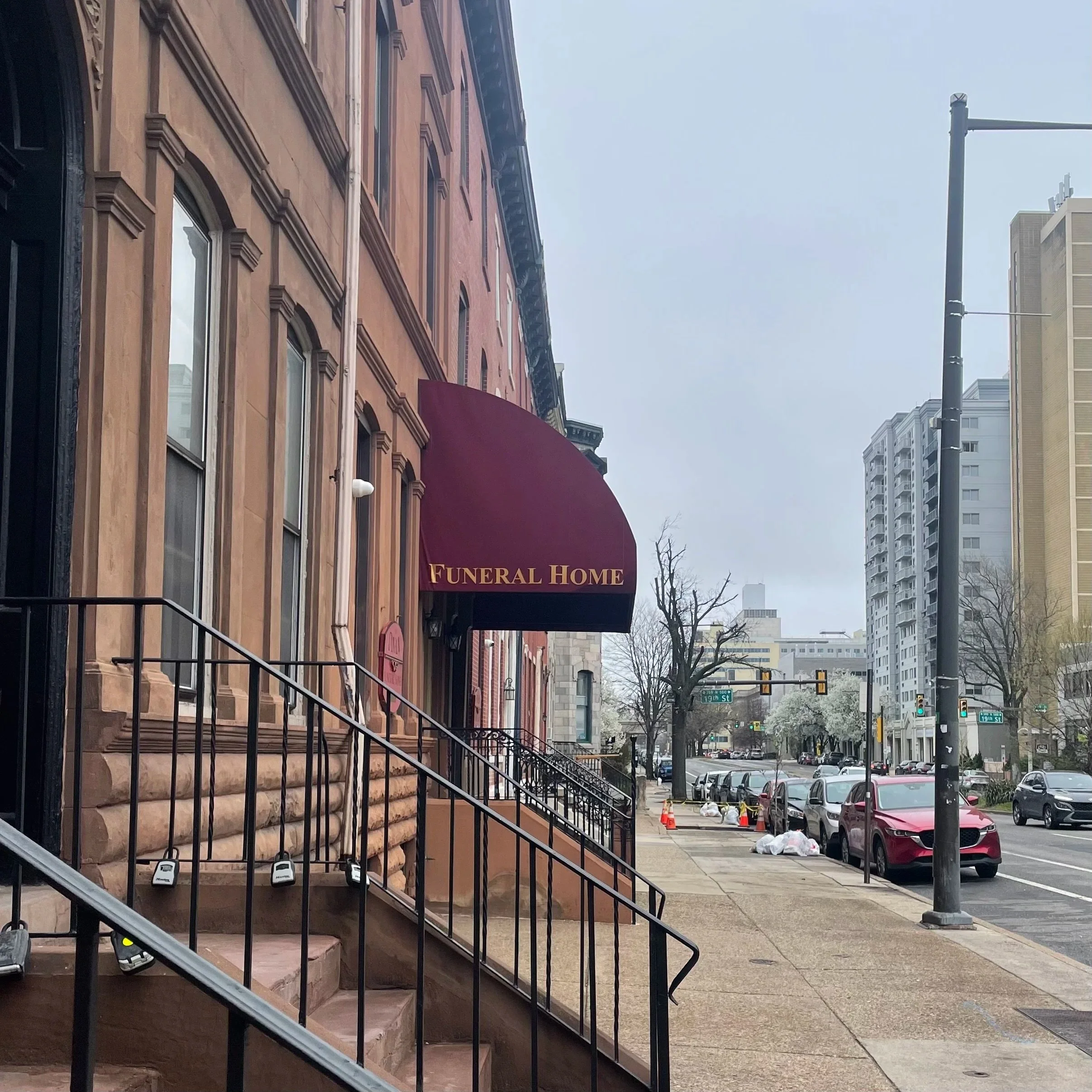
The day before St. Patty’s day, I was finishing the morning walk with the dog. I speak of the date to set a background of broken shamrock glasses and green confetti littering the already normal trash set out for city workers. The dog and I round onto our block to find a viewing underway. The funeral home, three doors down, has a lane of Spring Garden blocked and mourning vehicles squeeze between two orange cones.
There are two men somewhere in their twenties on the steps. One sitting sprawled under the crimson awning, the other stands lighting a cigarette. He is not immediately identifiable as to be of lamentation. Blue oversized and button up contrasts the fitted tan of his pants. He wears the red, green, and white kaleidoscope of Adidas street shoes. The puffs he pulls and words he converses with are absent of any hitch or crack.
Neither of them speak softly, nor do they speak loudly. Their pace is relaxed and accepting, open to one another.
As the dog and I pass, a woman holding a child comes out to join them. The one on the stairs takes up being a father while the mom tells a story from inside. I don’t hear the peak of it, but it reads as familial to the eye. Something shared over a drink in a way that gathers their loss.
As I push my key into our door and swing it open for the dog, I take one last look. The child holds her father’s hands while the conversation continues around her. The cigarette smoke collects under the clouds and no one laughs.
Uncle Ernest’s Journals: Claude-by-Cheese Vol.1
*Editor’s note (NC): Ruth came into some academic journals from a distant Great-Uncle and thought to publish them here for our readers to enjoy.
The town of Claude-by-Cheese, as the name suggests, was a collection of two dozen or so buildings on the banks of the slow churning Cheese river. It’s quite alright if you have never heard of it, the town hasn’t appeared on a map since 1919. This was mostly due to the ministrations of one particularly scorned ex-fiancé who had far too much power within the census bureau. Todd Billings returned from the first World War to find his fiancé (here too) had run off in his absence with a boy from Claude-by-Cheese. When it came time to do his job, Todd made sure the town was skipped and made it his personal mission to have it be completely ignored by anyone outside of Claude-by-Cheese. So that is how the town disappeared into the annals of bureaucratic petty revenge. Since then no one has particularly cared to correct the mistake.
Some eighty years after its disappearance, I (Ernest P. Archibald Mouse) hope to bring it back on to the map and into the cultural consciousness. The following will be my journal of my time and documentation of Claude-by-Cheese.
The way I arrived upon my current topic of study has lady fortune’s paws all over it. I was finishing some interviews with local dock mice, it was an anthropological review of the effects of maritime work on mice, when I overheard something that piqued my ears. The bartender was interrogating a salty gray whiskered mouse about a master cheese maker the sailor had reported to have met with. For those who don’t know, a master cheese maker requires decades of learning and refining techniques to achieve the title. There are only about a baker’s dozen currently alive in the entire world.
I saddled up to the old paw, bought him a drink, and lent my ear to his tale. What follows is a transcription of said tale.
My cousin knew a mouse that had a rat-scraper1 and was planning on taking it on a run past the blockade (this was back before the Free Mouse Agreement had been drafted) to the town of Porter-Pa. They had some half decent Havarti and fermented yogurt, which would fetch a pretty penny due to the trade restrictions. So myself and a couple others took that rat-scraper smooth on through to Porter-Pa. It went so easy for us that we got bloated with confidence. We spent the night traipsing the town in celebration of a job half done. Our tails were bitten through when one of our group threw an empty glass at some snickering bar patrons. The constables chased us down and out of town in the height of the night. In our haste and the gloom of darkness, we took the wrong branch out of Porter-Pa. Down the teeth of a furious river we bounced and splashed, eventually striking and sinking the vessel. Six mice went into the foam and churn. When I awoke, I was alone on a bank. Little micelings stood above me, sticks poised to prod my water logged bones. The river had washed me up into a town called Claude-by-Cheese and that’s where I dined upon the finest cheese mouse-kind has ever tasted.
I continued to ply the old mouse with drink and he told me about how he had never seen the cheese master in the flesh. There was always a willow reed screen that the master hid behind when you went into the little white-washed storefront. The old mouse had stayed in Claude-by-Cheese for a year, never feeling a strong pull to return to life outside of the little village. Then one day, while he helped the washer woman with her chores, he received a blow to the back of the head and fell unconscious. Later he awoke on a little raft floating down the river. He has searched for but never found Claude-by-Cheese again.
Intrigued by the mysterious cheese master and by the town itself I decided then in that dockside bar to find both. I never expected it to turn into the adventure of a lifetime.
To Be Continued…
Editor’s note: Claude-by-Cheese was a creation by the infamous editor, Taylor Anderson. If you want to know the origin story, please send a written request and check for $25 by carrier pigeon or another mail-delivery animal.
Ruth’s Book Corner
As previously mentioned in last month’s edition I have been in the laboratory cooking up a monster review. But by the time I hit page five of the document I knew I had reevaluated what was going on. There are times both as a reader and as a book reviewer that you get so wound up over how a book has bothered you, that it becomes impossible to explain it coherently. The rage just takes over and every small thing is a slight against you as a mouse. Laying out all of those slights is not worth reading about and entirely not entertaining. I had a fiery review but not one that would give anyone joy to read. Thus I have scrapped the review of Wrath by Sharon Moalem and Daniel Kraus for the far more enjoyable experience of Blue Pastures by Mary Oliver.
Before we fully move on, I will share my favorite quote from Wrath just as a little dig at the book. This quote comes with only 19 pages left in the book and the very climax of what is the New York rodent population led by a genetically enhanced rat taking over the city. This is the capping point of all of these idiot human characters causing this disaster to happen through their direct actions and hubris. When you have reached this point where you think that these humans really deserve all of this and have been truly horrible to the rats, which is why this rise up happened in the first place, the super rat goes…
“Humans helped humans … Have I been wrong the whole time?
Do humans have something rats do not” (Wrath pg. 290)
This after about 290 pages saying that rats have community and help one another. The idiocy of this had me putting the book down for a solid five minutes as I stared into nothingness after reading it.
With that off my chest, we can move onto a much more pleasurable reading experience. Blue Pastures is Mary Oliver’s 10th published book and her first work of prose, released in 1995. It fails to really fall on a general area of focus, which means the book is better off for that. This collection of writing has been the most expressive and intimate of Mary Oliver’s work as far as the clarity of how Oliver speaks. She pontificates, biographs, and spins thoughtfully crafted lines. She allows herself more room than in her poetry and still maintains a sharp eye towards crafting and the beautification of her lines.
I am in no way unbiased when it comes to Mary Oliver. Ever since the boss man hired me, I have heard the praise of Oliver sung from the rafters. My experience, because of this, is colored. But every time I pick up one of her books, it always seems to be the right time to enjoy it. Approachable for a nature lover and for those who appreciate a careful eye towards the human existence. Blue Pastures is easily my favorite non-poetry work of Oliver’s. It’s revealing and human with loving gentleness that wraps you comfortably in its words. This is a read anyone will enjoy and should enjoy.
-Ruth
Red Devil Motel: Part 3
The Red Devil Motel Series has been omitted here. You can read all of them over on the Substack.